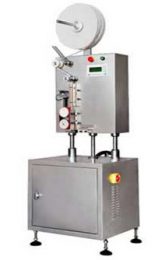


Semi Automatic Single Head ROPP Cap Sealing Machine - GMP Model – Manufacturer, Supplier, Exporter

Semi Automatic Single Head ROPP Cap Sealing Machine – GMP Model
The Semi Automatic Single Head ROPP Cap Sealing Machine – GMP Model is designed for sealing bottles with aluminum ROPP caps in pharmaceutical, food, beverage, cosmetic, nutraceutical and other suitable industries. The machine provides controlled cap placement and sealing through a single ROPP sealing head.
In semi-automatic operation, the operator places the bottle and cap in the required position, after which the machine performs the ROPP capping operation. The sealing head forms the aluminum cap around the bottle neck thread to create a secure and tamper-evident closure.
The GMP Model is designed with an emphasis on hygienic construction, accessible surfaces and suitability for controlled production environments. Machine configuration can be selected according to bottle dimensions, cap specifications, required sealing performance and production requirements.
What Is a Semi Automatic Single Head ROPP Cap Sealing Machine?
A Semi Automatic Single Head ROPP Cap Sealing Machine is a bottle sealing machine designed to apply and crimp aluminum Roll-On Pilfer-Proof caps onto compatible bottles.
The single-head configuration performs the ROPP sealing operation one bottle at a time. The operator positions the bottle and cap, and the machine then lowers the sealing head to form the cap around the bottle neck.
The GMP Model is suitable for applications where hygienic machine construction and controlled bottle sealing are important.
Working Principle
Bottle Positioning
The operator places the filled bottle at the designated sealing position below the ROPP sealing head.
Cap Placement
An aluminum ROPP cap is placed manually onto the bottle neck in the correct position.
Bottle Stabilization
The bottle is held securely during the sealing operation to maintain proper alignment.
Sealing Head Operation
The single ROPP sealing head moves into position over the bottle and starts the capping cycle.
ROPP Thread Formation
The rollers of the sealing head form the aluminum cap around the bottle neck thread according to the required profile.
Tamper-Evident Formation
The lower portion of the ROPP cap is formed to create the required tamper-evident connection with the bottle.
Sealed Bottle Removal
After completion of the sealing cycle, the sealed bottle is removed by the operator and the next bottle is positioned.
Salient Features
- Semi-automatic ROPP cap sealing
- Single-head sealing system
- GMP Model configuration
- Suitable for aluminum ROPP caps
- Controlled bottle positioning
- Consistent cap sealing operation
- Adjustable sealing parameters as applicable
- Compact machine design
- Stainless steel construction
- Easy operator operation
- Suitable for small and medium production requirements
- Reduced manual sealing effort
- Quick bottle handling
- Easy cleaning and maintenance
- Suitable for integration into semi-automatic packaging operations
Main Components
- Stainless steel machine frame
- Single ROPP sealing head
- Bottle holding arrangement
- Bottle positioning mechanism
- Sealing head drive mechanism
- ROPP sealing rollers
- Control panel
- Start/stop controls
- Safety arrangement
- Electrical control system
- Adjustable machine supports
Bottle Compatibility
The machine can be configured for compatible bottle formats used with aluminum ROPP caps.
Suitable bottle materials may include:
- Glass bottles
- PET bottles
- HDPE bottles
- Other compatible rigid containers
Final compatibility depends on bottle diameter, height, neck finish, thread profile and cap dimensions.
ROPP Cap Compatibility
The machine is designed for compatible aluminum ROPP caps.
Cap selection depends on:
- Cap diameter
- Cap height
- Aluminum cap thickness
- Bottle neck finish
- Thread profile
- Tamper-evident requirements
The sealing head and rollers should be selected according to the specific cap and bottle combination.
ROPP Cap Sealing System
The single-head ROPP sealing system forms the aluminum cap around the bottle neck through controlled roller movement.
The sealing rollers perform the required forming operation to create the bottle-neck thread and tamper-evident portion of the cap.
The final sealing quality depends on the bottle neck, cap dimensions, sealing-head configuration and machine settings.
Bottle Holding System
During sealing, the bottle is positioned and stabilized below the ROPP head.
Proper bottle holding helps maintain alignment between the bottle neck and sealing head and supports consistent cap formation.
The bottle holding arrangement can be selected according to the bottle shape and dimensions.
Technical Specifications
| Parameter | Specification |
|---|---|
| Machine Type | Semi Automatic Single Head ROPP Cap Sealing Machine |
| Model | GMP Model |
| Sealing System | ROPP Cap Sealing |
| Number of Heads | Single Head |
| Operation | Semi Automatic |
| Cap Type | Aluminum ROPP Cap |
| Bottle Feeding | Manual |
| Cap Placement | Manual |
| Sealing Operation | Automatic Cycle |
| Bottle Type | Compatible Glass / PET / HDPE Containers |
| Control System | Electrical Control Panel |
| Machine Construction | Stainless Steel |
| Sealing Adjustment | As per Application |
| Production Capacity | Application Dependent |
| Bottle Size | As per Customer Requirement |
| Cap Size | As per Customer Requirement |
| Power Supply | As per Machine Configuration |
| Change Parts | As Required |
Production Capacity
The Semi Automatic Single Head ROPP Cap Sealing Machine is intended for applications where bottles are manually loaded and unloaded.
Production capacity depends on:
- Bottle size
- Cap size
- Operator handling speed
- Sealing cycle time
- Bottle positioning
- Required sealing parameters
- Operator workflow
Actual output should be confirmed according to the bottle, cap and production requirements.
ROPP Sealing Quality
The machine is designed to provide repeatable ROPP cap formation when operated with compatible bottles and caps.
Sealing quality depends on:
- Bottle neck dimensions
- Cap dimensions
- Aluminum cap specifications
- Roller configuration
- Sealing-head adjustment
- Bottle positioning
- Machine settings
Proper setup and sample trials are recommended before final production.
GMP Model Construction
The GMP Model can be designed with stainless steel construction and accessible machine surfaces suitable for controlled production environments.
The machine layout can be configured to support cleaning, inspection and routine maintenance.
Actual material grades, surface finish and construction details should be confirmed according to the customer’s GMP and production requirements.
Cap Inspection
Inspection can be performed after the sealing operation to check the general appearance and formation of the ROPP cap.
Depending on the application, additional inspection equipment can be considered for:
- Cap presence
- Cap position
- Cap formation
- Tamper-evident ring formation
- Bottle condition
Hygiene and Cleaning
The machine can be designed for easy access to areas requiring routine cleaning.
Recommended cleaning activities include:
- Cleaning the sealing-head area
- Removing cap and product residues
- Cleaning bottle-contact areas
- Inspecting rollers
- Cleaning machine surfaces
- Checking moving components
Cleaning procedures should follow the production site’s established hygiene requirements.
Optional Features
Depending on the application, the machine can be configured with:
- Customized bottle holding arrangement
- Different ROPP sealing heads
- Adjustable sealing-head height
- Customized change parts
- Foot-operated cycle control
- Additional safety guarding
- Bottle presence sensing
- Cap presence sensing
- Digital controls
- Batch counter
- Customized stainless steel construction
- Special surface finish
Packaging Line Integration
The Semi Automatic Single Head ROPP Cap Sealing Machine can be used as part of a semi-automatic packaging process.
A typical sequence may include:
Bottle Filling → Manual Cap Placement → ROPP Cap Sealing → Inspection → Labelling → Coding → Packing
The actual sequence depends on the product, bottle, production volume and required level of automation.
Applications
Pharmaceutical Industry
Suitable for selected pharmaceutical liquid and other products packed in compatible bottles with aluminum ROPP closures.
Food Industry
Used for suitable food products requiring ROPP bottle sealing.
Beverage Industry
Suitable for compatible beverage bottles using aluminum ROPP caps.
Cosmetic Industry
Can be used for selected cosmetic and personal-care products requiring ROPP closures.
Nutraceutical Industry
Suitable for compatible nutraceutical and herbal product bottles.
Industries Served
- Pharmaceutical manufacturing
- Food processing
- Beverage manufacturing
- Cosmetic and personal care
- Nutraceutical manufacturing
- Herbal products
- Contract packaging
- FMCG manufacturing
Benefits
- Semi-automatic bottle sealing
- Single-head ROPP sealing
- Controlled aluminum cap formation
- Reduced manual sealing effort
- Compact machine configuration
- Suitable for lower-volume production
- Simple operator operation
- Repeatable sealing process
- Stainless steel construction
- Easy cleaning and maintenance
- Suitable for pharmaceutical and other controlled production applications
Changeover
Changeover requirements depend on the bottle and cap formats used.
Adjustments may include:
- Sealing-head height
- Bottle holding position
- Roller arrangement
- Bottle guide settings
- Change parts
The exact changeover procedure depends on the machine configuration and bottle formats.
Construction
The GMP Model can be manufactured using stainless steel construction suitable for industrial and controlled production environments.
The machine can be configured with accessible surfaces and a compact footprint to support routine cleaning and operation.
Material grades, surface finish and construction specifications can be customized according to the application requirements.
Safety Features
The machine can incorporate safety features such as:
- Emergency stop
- Safety guarding
- Electrical protection
- Sealing-head protection
- Operator safety controls
- Motor overload protection
The final safety configuration depends on the machine design and applicable site requirements.
Cleaning & Maintenance
Regular cleaning and preventive maintenance help maintain consistent ROPP sealing performance.
Recommended maintenance activities may include:
- Cleaning the sealing head
- Inspecting ROPP rollers
- Checking sealing-head movement
- Inspecting bottle holding components
- Checking electrical connections
- Cleaning stainless steel surfaces
- Inspecting fasteners
- Checking machine alignment
- Lubricating applicable components
Maintenance frequency should be determined according to machine usage and operating conditions.
Machine Selection Requirements
Before selecting a Semi Automatic Single Head ROPP Cap Sealing Machine, consider:
- Bottle diameter
- Bottle height
- Bottle material
- Bottle neck finish
- Neck diameter
- Cap diameter
- Cap height
- Aluminum cap specifications
- Required production output
- Required sealing profile
- Available floor space
- Operator workflow
- Required automation level
- GMP/environmental requirements
Bottle and cap samples or complete dimensional drawings are recommended for machine selection and configuration.
Why Choose This Machine?
The Semi Automatic Single Head ROPP Cap Sealing Machine – GMP Model is suitable for manufacturers requiring controlled and repeatable aluminum ROPP cap sealing without the investment or complexity of a fully automatic capping line.
Its single-head configuration provides a practical solution for small and medium production operations, development batches, contract packaging and applications where bottles are manually loaded.
The GMP-oriented construction can support hygienic production environments while maintaining a compact and straightforward operating arrangement.
Why Choose Multipack Machinery?
Multipack Machinery provides bottle capping and sealing machinery for pharmaceutical, food, beverage, cosmetic, nutraceutical and other industrial applications.
The Semi Automatic Single Head ROPP Cap Sealing Machine can be configured according to bottle dimensions, ROPP cap specifications, sealing requirements and production capacity.
Machine configuration, change parts and optional controls can be selected according to the customer’s application and packaging requirements.
Frequently Asked Questions
What is a Semi Automatic Single Head ROPP Cap Sealing Machine?
It is a semi-automatic machine that applies and seals aluminum ROPP caps onto compatible bottles using a single ROPP sealing head.
What does ROPP mean?
ROPP stands for Roll-On Pilfer-Proof. The aluminum cap is formed around the bottle neck to create the required threaded closure and tamper-evident feature.
What type of caps does the machine use?
The machine is designed for compatible aluminum ROPP caps.
Is the bottle loading automatic?
No. In the standard semi-automatic configuration, the operator positions the bottle for the sealing cycle.
Is cap placement automatic?
The standard semi-automatic operation involves manual cap placement before the sealing cycle.
How many sealing heads does the machine have?
This model uses a single ROPP sealing head.
What bottles can be sealed?
The machine can be configured for compatible glass, PET, HDPE and other rigid containers with suitable ROPP-compatible neck finishes.
What is the production capacity?
Capacity depends on bottle size, cap dimensions, sealing cycle time and operator handling speed.
Is this machine suitable for pharmaceutical applications?
It can be used for suitable pharmaceutical applications where compatible bottles and aluminum ROPP closures are required. Final GMP and regulatory suitability should be evaluated according to the specific installation and process requirements.
Can the machine be customized?
Yes. Bottle holding arrangements, sealing-head configuration, change parts, controls and other machine features can be customized according to the application.
Looking for a Semi Automatic Single Head ROPP Cap Sealing Machine – GMP Model? Contact Multipack Machinery with your bottle dimensions, ROPP cap specifications and required production capacity for a suitable machine configuration.